What are the Best Geological Exploration Drilling Tools?
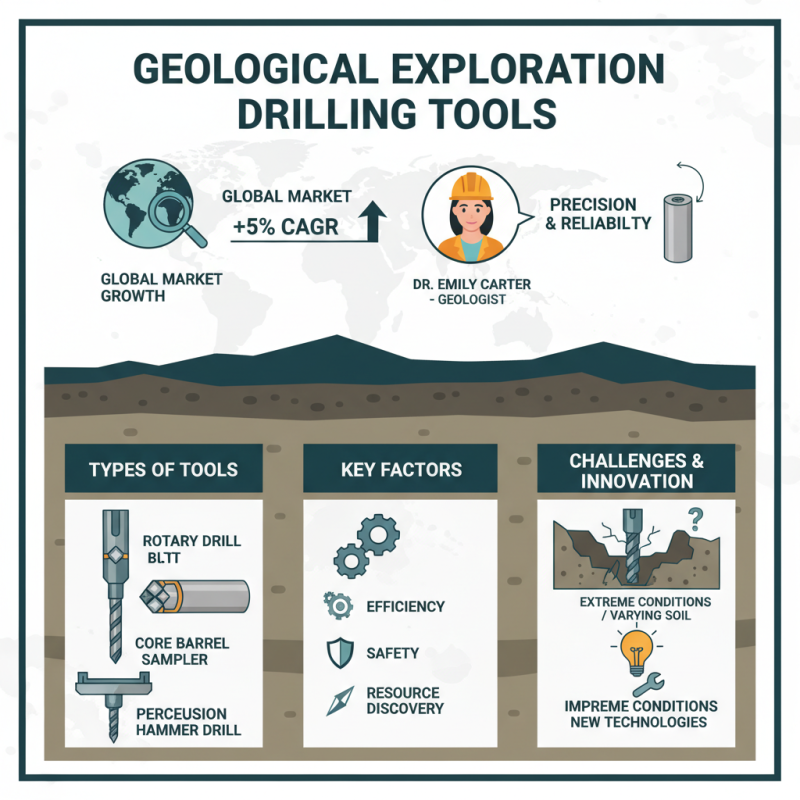
In the world of geological exploration, drilling tools play a crucial role. These tools help to uncover valuable resources hidden beneath the surface. According to a recent report by the Geological Society, the global market for Geological Exploration Drilling Tools is projected to grow at a CAGR of 5% over the next five years. This growth is driven by increasing demand for minerals and oil, especially in developing regions.
Expert Dr. Emily Carter, a leading geologist, emphasizes the importance of selecting the right tools. She states, "The effectiveness of geological exploration depends heavily on the tools we use." Her insight underscores the need for precision and reliability in drilling applications. The right Geological Exploration Drilling Tools can significantly impact efficiency and safety in the field.
While advances have been made, challenges still exist. Many tools struggle with extreme conditions or varying soil types. Addressing these issues requires ongoing innovation. The challenge is not only to find better tools but also to improve existing ones. As the industry evolves, it becomes crucial to adapt to new technologies and methodologies.
Fundamental Principles of Geological Exploration Drilling Tools
Geological exploration drilling tools are essential for uncovering subsurface resources. Understanding their fundamental principles enhances drilling effectiveness. A study from the Society for Mining, Metallurgy & Exploration indicates that proper tool selection can improve sample quality by up to 30%.
Rotary drilling is a widely used method. It employs a rotating drill bit that breaks rock while circulating fluid cools the bit and carries cuttings to the surface. This process often requires careful consideration of factors like rock type and geological structure. The International Journal of Rock Mechanics and Mining Sciences highlights that improper tool selection can lead to inefficient drilling and increased costs.
Core drilling provides a different approach. It extracts cylindrical samples of rock, offering invaluable insights into subsurface conditions. This method can achieve a recovery rate of 90% or more, according to a report by the American Society of Civil Engineers. However, it requires precise calibration of equipment. A poorly calibrated drill might result in wasted resources and unreliable data. Balancing tool functionality with geological conditions is crucial for exploration success.
What are the Best Geological Exploration Drilling Tools?
| Tool Type | Application | Material | Depth Capability (meters) | Cost Range (USD) |
| Diamond Core Drill | Geological Coring | Diamond | 0-3000 | 20,000 - 50,000 |
| Rotary Drill | Mineral Exploration | Steel | 0-2000 | 10,000 - 30,000 |
| Auger Drill | Soil Sampling | Carbon Steel | 0-30 | 1,000 - 5,000 |
| Reverse Circulation Drill | Mining Exploration | Steel | 0-1500 | 15,000 - 40,000 |
| Air Rotary Drill | Water Well Drilling | Steel | 0-1000 | 12,000 - 35,000 |
Types of Drilling Techniques Used in Geological Exploration
In geological exploration, drilling techniques play a crucial role in obtaining subsurface information. Common methods include rotary drilling, core drilling, and auger drilling. Rotary drilling utilizes a rotating drill bit to penetrate rock and soil. It is effective in both soft and hard formations, providing a continuous sample of the geological layers.
Core drilling is another technique that offers valuable insight. This method extracts cylindrical samples, or cores, from the ground. It allows geologists to analyze mineral content and rock characteristics in detail. However, this technique can be time-consuming and may require extensive preparation. The choice of drilling method often depends on the specific geological conditions and the objectives of the exploration.
Auger drilling is typically used for shallow depths. It is effective in soil exploration and can quickly retrieve samples. However, it may not reach deeper formations where more advanced methods are needed. Each technique has its pros and cons. Geologists must evaluate the project’s needs carefully. Consideration of budget, time constraints, and the nature of the material being explored is essential. Proper assessment can lead to successful exploration outcomes.
Key Features of Effective Geological Drilling Equipment
When selecting geological exploration drilling tools, effective equipment is vital. High-performance drill rigs should provide reliable core samples. These tools need to handle various geological formations, from soft soil to hard rock. A robust design ensures durability and longevity. Must include features like adjustable speed and torque to adapt to different drilling conditions.
Portability matters too. Lightweight equipment can be moved easily to different sites. Additionally, eco-friendly options reduce the environmental impact of drilling activities. Operators should consider ease of maintenance. Simple maintenance routines prolong the lifespan of drills and minimize downtime. It also reflects a commitment to sustainability in geological exploration.
However, not all tools perform equally well under varying conditions. Some may falter in extreme temperatures or challenging terrains. Evaluating user experience is essential, as it can highlight potential drawbacks. Feedback from field experts offers valuable insights. Always prioritize equipment that balances performance with adaptability and resilience. This contributes to more effective geological drilling outcomes.
Best Geological Exploration Drilling Tools
Recent Innovations in Drilling Technology for Geological Surveys
Recent advancements in drilling technology have significantly transformed geological surveys. Innovative tools now enhance efficiency and data quality. For instance, advancements in rotary drilling techniques allow for deeper penetration and better core samples. A study from the International Journal of Rock Mechanics highlights that these new systems can reach depths of over 3,000 meters, providing invaluable geological data.
Moreover, the integration of real-time data monitoring systems has reshaped geological exploration. These systems enable drillers to adjust techniques on the fly, reducing time spent on-site. Recent reports indicate that real-time feedback can decrease operational costs by approximately 15%. However, challenges remain. Some drilling equipment can fail under extreme conditions. This creates potential setbacks and highlights the need for continual innovation.
Furthermore, eco-friendly approaches are emerging within the industry. New biodegradable drilling fluids are now available, minimizing environmental impact. A report by the American Society of Civil Engineers emphasizes managing ecological footprints in drilling operations. Even with these innovations, companies must remain vigilant about balancing technology and sustainability.
Statistical Analysis of Drilling Efficiency and Cost-Effectiveness
In geological exploration, drilling tools play a crucial role in determining the efficiency of data collection. An effective drilling tool must provide accurate samples while minimizing costs. A recent analysis showed that simpler, lightweight tools often performed better in speed but lacked the precision needed for deep exploration. Balancing speed with accuracy remains a challenge.
Cost-effectiveness is also a significant concern. Tools with higher upfront costs may lead to savings in the long run through improved efficiency. Data analysis indicated that investing in advanced materials increased the longevity of drilling tools. However, not every project may justify such expenses, leading to potential over-investment in certain scenarios.
This evaluation highlights the need for careful consideration of drilling technology choices. Smaller projects often struggle to justify high-end tools. It raises questions about whether a modular approach could offer a cost-effective solution without sacrificing quality. Ultimately, ongoing assessment of drilling performance is necessary to identify areas for improvement. Emphasizing adaptability can enhance both efficiency and effectiveness.