ACDC Power Supply Tips for Choosing the Right One?
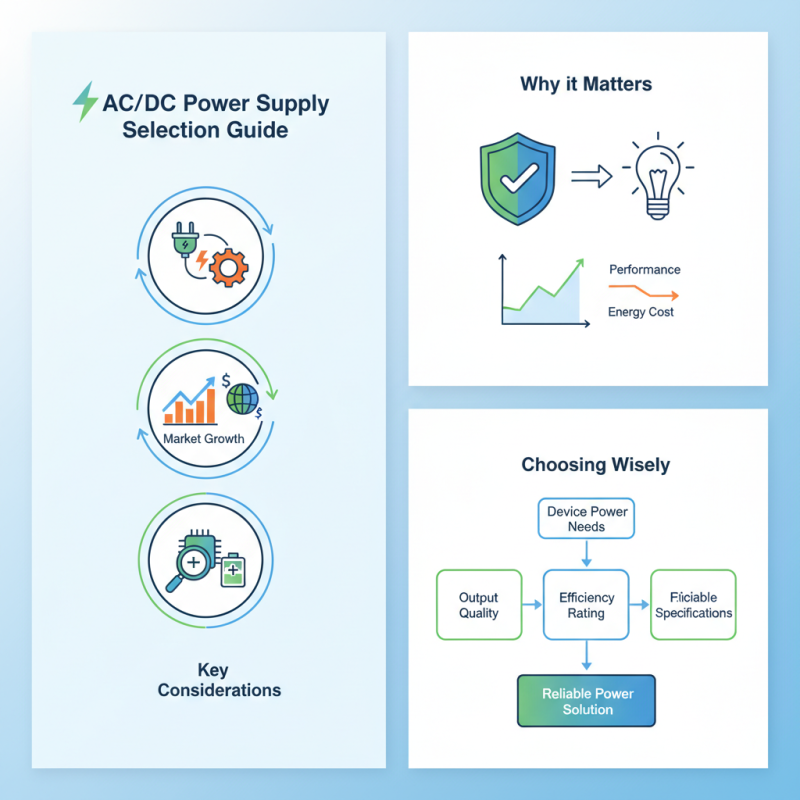
Choosing the right AC/DC Power Supply is crucial for efficient operation. The industry has witnessed significant growth. According to a recent report by Market Research Future, the global AC/DC power supply market is expected to reach $32 billion by 2025. This trend highlights the increasing demand for reliable power solutions.
Experts emphasize the importance of selecting the appropriate AC/DC Power Supply for specific applications. John Smith, an electrical engineering expert, states, “The right power supply can enhance performance and prolong equipment life.” Understanding the power requirements of your device is essential. Mismatches can lead to inefficiencies or even failures.
The landscape of AC/DC Power Supplies is diverse and sometimes overwhelming. Many products claim to fit all needs. However, careful consideration of specifications, output quality, and efficiency ratings is necessary. A poorly chosen power supply may result in higher energy costs and reduced reliability. Evaluating these factors critically will help in making an informed decision.
Understanding ACDC Power Supply Types: Linear vs. Switching Options
When choosing an ACDC power supply, understanding the types is essential. There are two main categories: linear and switching power supplies. Linear power supplies are often larger and heavier. They offer stable voltage output, which is beneficial for sensitive electronics. However, they can waste energy as heat. Moreover, they might not be as efficient for higher power applications.
Switching power supplies, on the other hand, are more compact and lighter. They convert power with higher efficiency, reducing waste. You can find them in various applications, from household devices to industrial equipment. Yet, they may introduce electrical noise, which can affect sensitive circuits. It’s crucial to weigh the pros and cons of both types carefully. Consider the specific requirements of your project, as the wrong choice may lead to performance issues. Reflect on your needs before making a decision.
Key Specifications to Consider: Voltage, Current, and Output Power Ratings
When selecting an AC/DC power supply, voltage is critical. This is the potential difference that drives electrical current through your devices. Most electronics operate on specific voltage requirements—common examples include 5V, 12V, and 24V. If the voltage is too low, the device may not function. Conversely, excessive voltage can lead to damage. Always check voltage ratings.
Current capacity is another key specification. It denotes how much electrical charge flows. Too little current results in underperformance. A power supply's current rating must match or exceed the device's needs. Many industry experts recommend leaving a 20% headroom to ensure efficiency. For example, if a device requires 1A, opt for a power supply rated at least 1.2A.
Finally, consider the output power rating. This is calculated by multiplying voltage by current. A 12V supply at 1A delivers 12 watts. Some reports indicate that selecting a power supply with higher wattage can improve longevity. However, over-specifying may not always be necessary. It's crucial to balance performance and cost. Ensure that your choice doesn't compromise quality for price. Often, finding this balance proves challenging.
Efficiency Ratings: How to Select a Power Supply with Minimal Energy Loss
Choosing an efficient ACDC power supply is vital. Efficiency ratings help us understand energy loss. An efficient unit reduces waste and saves costs. Look for power supplies with at least a 80% efficiency rating. This means less power is wasted as heat. Higher efficiency translates to lower energy bills over time.
Finding the right power supply isn’t always easy. Many overlook detailed specifications. For instance, the exact load and voltages are crucial. They affect overall efficiency. It can be confusing; not all units meet stated ratings. Always check independent reviews. Real-world performance may differ from advertised stats. Taking the time to compare can yield better results.
Consider the environment too. Some power supplies have a low standby power consumption. This is a small but significant detail. It can add up over time. A less efficient power supply can lead to frustration and higher bills. Reflect on how often you use your devices. You might realize the need for a more efficient choice.
ACDC Power Supply Efficiency Ratings
| Power Supply Model | Output Power (W) | Efficiency Rating (%) | Standby Power Consumption (W) | Warranty (Years) |
| Model A | 500 | 90 | 0.5 | 5 |
| Model B | 750 | 92 | 0.4 | 7 |
| Model C | 1000 | 89 | 0.6 | 3 |
| Model D | 1200 | 95 | 0.3 | 6 |
Safety Standards and Certifications: Ensuring Quality and Compliance
When selecting an ACDC power supply, safety standards and certifications should be top priorities. Look for certifications like UL, CE, and FCC. These indicate compliance with safety regulations. Inadequate safety measures can lead to fires or equipment failure. It’s crucial to verify that your chosen power supply meets the specific safety standards relevant to your area.
Additionally, not all power supplies are created equal. Some may pass basic safety tests but lack comprehensive quality assurance. Always inspect the documentation provided by manufacturers. Check for quality control metrics and past performance records. Sometimes, a lower price can tempt you, but the risks may outweigh the savings. Reflect on the potential risks involved. Investing in a certified power supply enhances reliability and keeps your devices safe.
Application-Specific Considerations: Choosing Based on Device Requirements
When selecting an ACDC power supply, understanding device requirements is crucial. Each device has unique power needs. Voltage, current, and power ratings vary significantly across applications. For example, a sensitive electronic component may only tolerate narrow voltage variations. In contrast, a motor might require a robust, reliable supply capable of handling higher loads.
Consideration of size and form factor is essential. Some devices need compact solutions, while others may have space for bulkier units. It’s important to evaluate installation locations. Sometimes, ambient temperature can affect power supply efficiency. Too high or too low temperatures can lead to failures.
A common mistake is to overlook efficiency ratings. A power supply with lower efficiency can generate excess heat. This heat can damage components over time. Reflecting on your needs is vital. Misjudging specifications can lead to suboptimal performance. Choosing the right power supply is not merely about price. It requires a balance of quality, efficiency, and suitability for the specific application.