Top Tips for Navigating the Optical Sorter Market Today?
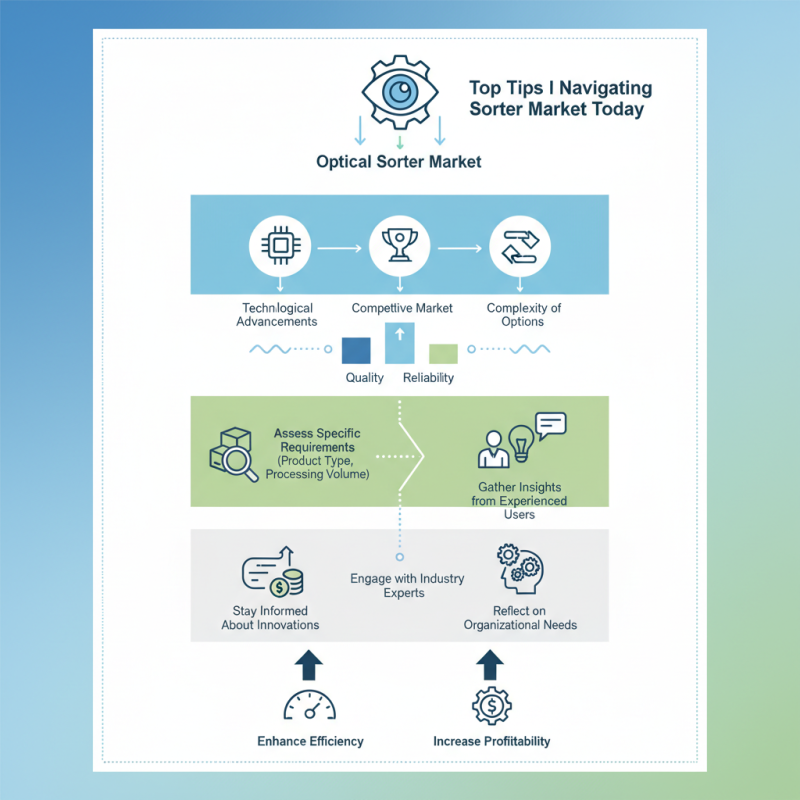
Navigating the Optical Sorter Market can seem overwhelming. With rapid technological advancements, many companies are vying for attention. The complexity of options makes choices challenging. You need to prioritize quality, reliability, and performance. The optical sorter market is highly competitive, presenting both opportunities and pitfalls.
Each solution offers unique benefits, but not all will suit your needs. It's essential to assess specific requirements carefully. Consider factors like product type and processing volume. Engaging in discussions with industry experts can provide clarity. Gathering insights from experienced users can help identify the right technology.
Market trends can shift, impacting your decisions. Staying informed about innovations is critical. As you explore options, reflect on what truly matters for your organization. An informed choice can enhance efficiency and profitability. Ultimately, navigating this market requires diligence and understanding.
Understanding the Basics of Optical Sorting Technology
Optical sorting technology is revolutionizing the processing industry. This advanced method uses sensors to identify and separate materials based on various properties. By employing cameras and lasers, optical sorters enhance efficiency and precision in sorting operations. They are widely used in food, recycling, and manufacturing sectors.
When navigating the optical sorter market, consider key factors. Prioritize your needs. Understand what materials you will be sorting and the required throughput. Different sorts have unique capabilities. Do thorough research and seek expert advice. Reputable sources can help you make informed decisions.
Cost is another critical aspect. Assess your budget and the total cost of ownership. Invest in technology that will provide a good return on investment. Keep in mind that advanced models may offer features that save time and resources.
Testing equipment before purchasing is advisable. Many suppliers offer demonstrations or trials. Embrace this opportunity to evaluate performance in real conditions. Users often overlook the importance of training. Proper training ensures optimal use of the sorter and maximizes efficiency. Address these considerations, and you'll be on the right track in the optical sorting market.
Key Factors to Consider When Choosing an Optical Sorter
When considering an optical sorter, it's crucial to assess several key factors. The first factor to investigate is the imaging technology used. Different technologies offer varying levels of accuracy. Make sure to understand the differences in resolution and speed. Optical sorters often need to perform in high-paced environments, so select one that meets your productivity demands.
Another important aspect is the integration capabilities. An optical sorter should fit seamlessly with your existing systems. Look for models that allow for easy data sharing and machine communication. This ensures you can track performance metrics and make data-driven decisions.
Don't overlook after-sales support and maintenance. A reliable optical sorter requires consistent upkeep. Check if the supplier provides training and ongoing assistance. This can save you time and minimize downtime. A well-supported system stands a better chance of staying efficient over the long run.
Always reflect on your specific needs. Every operation is unique, and what works for one business might not suit another. Take time to evaluate your sorting requirements, budget constraints, and future growth plans. Balancing these considerations will guide you toward the most suitable optical sorting solution.
Comparative Analysis of Leading Optical Sorter Brands
The optical sorter market has seen rapid advancements, with several brands competing for dominance. According to recent industry reports, the global optical sorting market is projected to reach $1.6 billion by 2025, reflecting a compound annual growth rate of 10.5%. This growth is driven by increasing demand for quality product sorting in food, recycling, and mining industries.
A comparative analysis of leading optical sorter brands reveals significant variations in technology. Many brands utilize near-infrared (NIR) sorting, while others focus on multispectral imaging capabilities. The effectiveness of these technologies can vary depending on the application. For instance, while some sorters excel in removing contaminants from fruits and vegetables, others are better suited for plastic recycling.
However, not every optical sorter performs equally well. Some users report challenges with equipment maintenance, which can impact operational efficiency. Additionally, the initial investment costs may deter smaller operations from entering the market. Stakeholders must carefully evaluate their specific needs against sorter capabilities to ensure a suitable match. A failure to do so could lead to unexpected costs and operational setbacks.
Top Tips for Navigating the Optical Sorter Market Today
Evaluating the Efficiency and Output of Optical Sorters
When evaluating the efficiency of optical sorters, it's crucial to understand their sorting accuracy and operational speed. A report from the Association of Plastic Recyclers indicates that high-quality optical sorters can achieve over 95% accuracy in material separation. This level of precision directly impacts material recovery rates, which can exceed 90% in optimal conditions. However, achieving these rates often requires precise calibration and consistent maintenance.
Optimization for specific materials can lead to varying outputs. For example, while optical sorters excel with single-stream recyclables, they may struggle with mixed materials. A recent study revealed that defects in sorting, such as missed contaminants, occur in about 15% of cases. Regularly reviewing sorting parameters and worker training can help mitigate this issue. Additionally, performance can degrade over time, necessitating periodic assessments to maintain effectiveness.
Data from industry experts suggest that operators should monitor throughput regularly. While many assume that higher volume equates to better efficiency, this isn't always true. Sometimes, too much speed can lead to errors, reducing overall output. Balancing speed and accuracy remains a nuanced challenge that requires ongoing evaluation.
Future Trends in the Optical Sorter Market and Innovations
The optical sorter market is rapidly evolving, driven by innovation and increased efficiency demands. A recent industry report indicates that the market is projected to grow at a CAGR of 9% from 2023 to 2030. This growth stems from rising demands for quality assurance and operational efficiency in various sectors. High-performance sensors and advanced algorithms are becoming standard features in state-of-the-art optical sorters. These technologies enhance detection capabilities and improve separation accuracy, which are essential in food processing and recycling industries.
Moreover, sustainability trends are shaping the future of optical sorting technology. Companies are now emphasizing systems that minimize waste while maximizing yield. The integration of AI and machine learning algorithms allows for real-time data analysis, enhancing decision-making processes. However, the implementation of these advanced technologies is not without its challenges. Industries must remain agile, balancing the cost of new systems against potential returns. Failure to fully integrate these innovations could lead to a waste of resources.
Ongoing research and development are crucial as companies strive to enhance their sorting capabilities. Data from market analytics reveals that businesses adopting newer technologies significantly reduce operational costs over time. Yet, a common oversight is neglecting employee training on new systems, which can stifle the effectiveness of these high-tech solutions. Addressing such gaps is vital for organizations aiming for optimal performance in the ever-changing optical sorter landscape.